


Every online store wants to attract more organic traffic and boost sales — and eCommerce SEO is one of the most effective ways to achieve that. In this complete guide to eCommerce SEO, you’ll learn what it is, why it matters for your online business, and how it works to help your store rank higher, drive targeted traffic, and increase conversions. If you’re looking for a reliable E-Commerce Service in Ahmedabad, this guide will also help you understand how the right SEO strategy can grow your online store locally and globally.
What Is Ecommerce SEO?
Ecommerce SEO is the process of optimizing an online store so it ranks higher in search engines like Google and Bing. It focuses on improving product pages, category pages, website structure, content, and technical elements to make your store easier for search engines to understand and index.
The main goal of ecommerce SEO is to increase your online visibility and attract highly targeted shoppers through organic (non-paid) search results. When your products appear at the top of search results, more potential customers can discover your store without you having to rely heavily on paid advertisements.
A strong ecommerce SEO strategy also improves user experience by making your website faster, mobile-friendly, and easy to navigate. Over time, this helps build trust, drive consistent traffic, reduce marketing costs, and increase long-term sales growth for your online business.

Common tasks involved in ecommerce SEO include:
- Conducting keyword research to find what your customers are searching for
- Optimizing product and category pages with relevant target keywords
- Improving website structure for better navigation and crawling
- Creating high-quality, helpful content
- Building backlinks from other trusted websites to increase authority
- And implementing other technical and on-page improvements to boost search visibility
Why Is SEO Important for Ecommerce Websites?
SEO is essential for ecommerce websites because it helps increase organic traffic and generate more sales. When your online store ranks higher in search engine results, more potential customers can discover your products which directly improves your chances of conversions and revenue growth.
A strong ecommerce SEO strategy allows you to attract targeted shoppers who are already searching for products like yours. Unlike paid ads, SEO brings consistent traffic without ongoing advertising costs, making it a long-term and cost-effective growth strategy.
Using SEO for ecommerce websites also helps you:
- Reach customers without relying completely on paid ads
- Build credibility, as users often trust organic results more than sponsored listings
- Gain a competitive advantage over stores that are not properly optimized
When combined with SEO, social media marketing, and digital marketing strategies, ecommerce businesses can build stronger brand visibility and customer trust. If you are looking for a professional E-Commerce Service in Ahmedabad, integrating SEO with a complete digital marketing plan can help scale your online store faster and more sustainably.
6 Tips for Successful SEO in Ecommerce
1. Perform Keyword Research
Keyword research means finding the words and phrases people type into Google when they are searching for products like yours. These keywords help you understand what your potential customers are looking for online.
When you add the right keywords to your product and category pages, your website has a better chance of ranking higher in search results. Higher rankings mean more people can find your store, which can lead to more sales.
While doing keyword research, it’s important to understand search intent. Search intent is the reason behind someone’s search — what they actually want to find or do. If your page matches their intent, it has a better chance of ranking well on search engine results pages (SERPs).
There are four main types of search intent:
- Navigational: The user wants to visit a specific website
- Informational: The user wants to learn something
- Commercial: The user wants to compare products before buying
- Transactional: The user is ready to buy
For ecommerce websites, commercial and transactional keywords are very important because these users are more likely to purchase your products.

2. Improve Your Site’s Architecture
Site architecture means how you organize your website — including your pages, product categories, individual products, and blog posts.
For ecommerce websites, having a clear and simple structure is very important for technical SEO.
A well-optimized site structure:
- Helps Google easily crawl and index your product and category pages
- Makes it simple for users to find products quickly
- Passes link equity (ranking power) across your website to improve overall rankings
So, how can you improve your site architecture?
Start by organizing your website in a way that allows visitors to reach any product from your homepage within just a few clicks. The fewer clicks it takes, the better it is for both users and search engines.
For example, large ecommerce brands like Chewy use clear navigation menus. With a well-structured drop-down menu, users can move from the homepage to category pages in just two clicks, making browsing fast and easy.
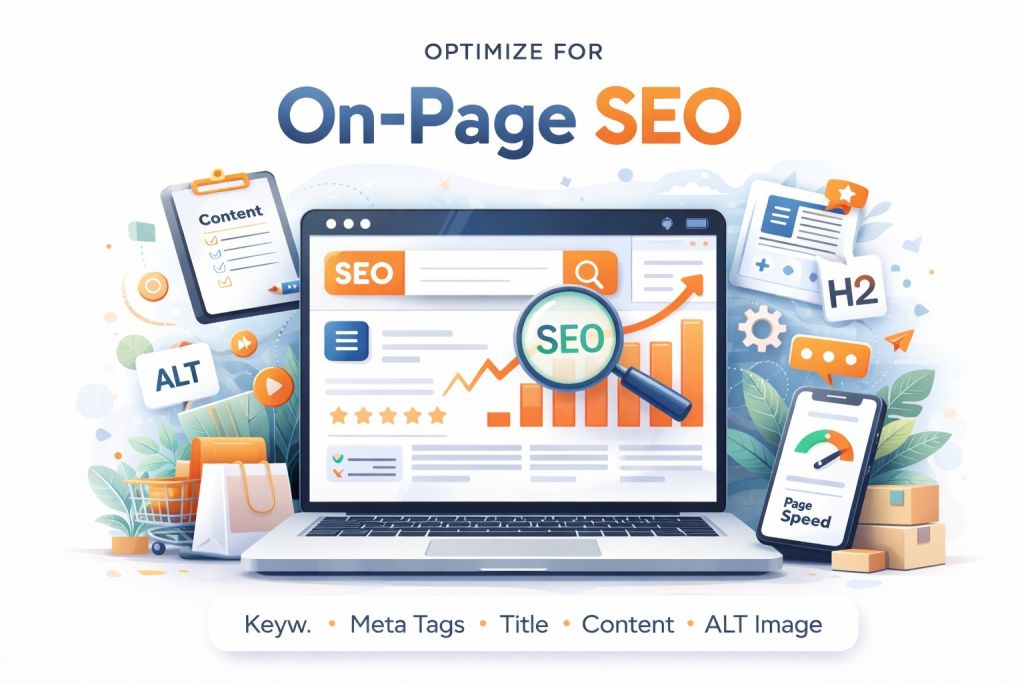
3. Optimize for On-Page SEO
On-page SEO means improving individual pages on your website so they can rank higher in search results.
For ecommerce websites, this mainly includes product pages and category pages.
Let’s understand how to optimize them properly.
Optimize Your Title Tags and Meta Descriptions
A title tag is the clickable headline that appears in search results. A meta description is the short text shown below it. Sometimes Google may rewrite them, but you should still optimize both for better results.
Title tags are one of the most important on-page SEO elements for any website. Google uses them to understand what your page is about, and they can directly affect your rankings.
Your title tag should:
- Be under 60 characters (not a strict rule, but longer titles may get cut off)
- Clearly describe what the page is about
- Include your main target keyword
- Encourage users to click
Meta descriptions are not a direct ranking factor. However, they can influence whether someone clicks on your result. A strong and clear description can improve your click-through rate (CTR).
Here are some simple tips for better meta descriptions:
- Keep them around 105 characters to avoid getting cut off
- Write a unique description for each page
- Highlight benefits like “free shipping,” or “buy one, get one free”
- Add your main keyword naturally.
Create an SEO-Friendly URL Structure
Google often shows your URL in search results to help users understand where they will land after clicking. The words in your URL can also slightly impact your search rankings.
Follow these best practices when creating URLs for your ecommerce website:
- Keep URLs short, clear, and descriptive
- Use hyphens (-) to separate words, not underscores (_)
- Always use lowercase letters
- Avoid adding dates, as they can make URLs look outdated
- Include your main keyword naturally
A clean and optimized URL improves both user experience and search visibility.
Optimize Your Product Images
Optimized images can rank in Google Image Search, bringing extra traffic to your website and increasing brand awareness.
Here’s how to optimize your images properly:
1. Use Clear File Names: Image file names help Google understand what the image is about.
2. Add Alt Text: Alt text is a short description of the image. It helps search engines understand the image content. It also improves accessibility because screen readers use alt text to describe images to visually impaired users.
3. Compress Your Images: Large image files can slow down your website. Compressed images improve page speed and user experience.
Add Unique Content to Every Page
Each page on your website should have unique content. This helps your pages rank for different search queries and prevents duplicate content issues. If you have many products, writing unique content can be challenging. Use this simple product page structure:
1. Product Name: Use the full and specific name.
2. Short Description (50–100 words): Highlight key features and benefits. Avoid copying generic descriptions.
3. Features Section: List detailed features such as ingredients, nutrition facts, and health benefits. Do not repeat the same features across all products.
4. Detailed Description: Write a longer paragraph explaining the product’s benefits and why customers should buy it. This is your opportunity to sell the product effectively.
What About Duplicate Content in Different Languages?
Large ecommerce websites often have different versions of pages for different countries or languages. In this case, use hreflang tags to tell Google which version is meant for which region or language. This helps avoid duplicate content problems and ensures the right audience sees the correct version.
Focus on Internal Linking
Internal linking means connecting one page of your website to another page on your site. When done correctly, internal links help distribute ranking strength across your website and improve SEO.
One simple strategy is to display related products on each product page. Although this may require some development work, it improves SEO, enhances user experience, encourages customers to explore more products and increases conversion chances.
Add Schema Markup
Schema markup is a special type of code added to your website to help Google understand your content better. When you add schema markup, your pages may appear with rich snippets in search results. These can show ratings, reviews, prices and Product availability. Rich snippets make your listings more attractive and can improve your click-through rate. For ecommerce websites, Product schema markup is especially important because it helps your products stand out from competitors.

4. Leverage Content Marketing
Content marketing is the practice of promoting your brand by creating and sharing valuable, relevant content such as blog posts, videos, email newsletters, and social media updates. Instead of directly advertising products, it focuses on providing helpful information that attracts and engages your target audience.
A well-planned content marketing strategy can significantly enhance your ecommerce SEO by driving targeted visitors to your website, earning backlinks from other reputable sites, increasing brand awareness and trust, and offering useful insights to potential customers. To develop an effective ecommerce content strategy, it is important to consider the sales funnel and create tailored content that addresses the needs and interests of customers at each stage of their buying journey.
Create Bottom-of-the-Funnel (BoFu) Content
Bottom-of-the-funnel (BoFu) content targets customers who are close to making a purchase decision.
These users are already interested in buying, so the right content can help convert them into customers.
Examples of BoFu content include:
- Product comparisons
- Best product lists
- Customer reviews and testimonials
This type of content helps customers make confident buying decisions.
Promote Your Content
After publishing blog content on your ecommerce website, promote it on social media platforms.
This helps you:
- Reduce dependence on Google traffic
- Reach a wider audience
- Increase brand visibility
- Drive additional website visitors
Don’t promote only sales-focused content. Educational, helpful, or entertaining content also performs well on social media and can attract potential customers who may later buy from you.
5. Manage Your Website’s Technical SEO
Technical SEO ensures that your website runs smoothly and is easy for search engines to crawl and index.
Use HTTPS for Website Security
HTTP (Hypertext Transfer Protocol) allows web browsers and servers to communicate. HTTPS is the secure version of HTTP.
HTTPS:
- Encrypts data between your website and visitors
- Protects sensitive information like passwords and credit card details
- Builds user trust
- Is a confirmed (though lightweight) Google ranking factor
To check if your website uses HTTPS, open it in a browser and look for the lock icon in the address bar. Using HTTPS is essential for ecommerce websites, especially when handling customer payments and personal information.
Make Your Online Store Mobile-Friendly
Making your online store mobile-friendly is essential because Google uses mobile-first indexing, meaning it primarily evaluates the mobile version of your website when determining search rankings. To improve mobile performance and potentially increase your visibility in search results, you should use a responsive design that automatically adjusts to different screen sizes.
Adding a viewport meta tag ensures that your pages display correctly on mobile devices, while making sure text is readable without zooming enhances user experience. It is also important to leave enough space between links, buttons, and other clickable elements so users can navigate easily. Providing a smooth and seamless mobile experience not only supports better SEO performance but also increases conversions.
Submit Your Sitemap to Google
Submitting your sitemap to Google is another important step in optimizing your ecommerce website. A sitemap is a file that lists all the key pages on your site, such as product pages, category pages, and blog posts, helping search engines discover and index them efficiently. This is particularly valuable for ecommerce sites that may contain hundreds or even thousands of pages.
Improve Your Page Speed
Improving your page speed is crucial for both SEO and user experience. Page speed refers to how quickly your website pages load, and for ecommerce websites, fast loading times are especially important. Slow pages can lead to higher bounce rates, as visitors may leave before completing a purchase. Additionally, page speed is a ranking factor in search engines, meaning it directly affects your visibility. By optimizing your website’s speed, you create a better user experience, encourage visitors to stay longer, and ultimately increase conversions.
6. Build Backlinks
Backlinks are links from other websites that point to your website. They are one of the most important ranking factors for Google.
Think of backlinks as votes of trust. When trusted and relevant websites link to your site, it signals to Google that your content is valuable and reliable.
The more high-quality backlinks you earn from reputable websites, the stronger your chances of improving your search rankings.
Find and Fix Technical SEO Issues
Technical SEO problems can affect any website, but ecommerce sites are especially vulnerable because they usually have many pages.
The more pages you have, the higher the chance of errors such as:
- Broken links
- Duplicate content
- Crawl issues
- Indexing problems
Since many ecommerce pages are designed to generate sales, it’s important that they function properly.
Ecommerce SEO Tools to Track Your Performance
Managing ecommerce SEO without proper tools can be challenging. You need reliable tools to monitor your progress and results.
SEO tools can help you:
- Find keyword opportunities
- Identify technical issues
- Track rankings
- Build backlinks
Here are some useful tools:
A.) Semrush Position Tracking
This tool shows whether your SEO efforts are improving your rankings. It tracks keyword positions and shows which keywords have gained or lost visibility over time.
B.) Google Search Console
A free tool that helps you:
- Monitor organic traffic
- Check indexing status
- Identify website issues
- Fix search performance problems
C.) Google Analytics
Another free tool from Google that tracks:
- Website traffic
- User behavior
- Conversions
- Sales performance
Use Ecommerce SEO to Grow Your Business
Improving your ecommerce SEO can lead to:
- Higher search rankings
- Increased organic traffic
- More conversions and sales
However, search rankings can change due to:
- Google algorithm updates
- Increased competition
Final Thoughts
eCommerce SEO is not just about improving rankings it’s about building a powerful online store that attracts the right customers, delivers a seamless experience, and consistently drives sales. From keyword strategy and technical SEO to content marketing and backlink building, every step plays a critical role in long-term success.
When implemented strategically, eCommerce SEO becomes a sustainable growth engine that increases organic traffic, strengthens brand authority, and reduces dependency on paid advertising.
If you are looking for a reliable e-commerce service in Ahmedabad, Chimplab Advertising offers result-driven eCommerce SEO strategies tailored to your business goals.
Ready to dominate search results and grow your online store?
Partner with Chimplab Advertising – your trusted e-commerce service in Ahmedabad and let our experts create a customized SEO strategy that drives traffic, boosts conversions, and scales your revenue. Get in touch today and start building long-term online success.
Frequently Asked Questions
1. What is eCommerce SEO?
eCommerce SEO is the process of optimizing an online store to improve its visibility in search engines and attract high-intent organic traffic.
2. How long does eCommerce SEO take to show results?
Typically, businesses see noticeable improvements within 3 to 6 months, depending on competition and website condition.
3. Why is technical SEO important for eCommerce websites?
Technical SEO ensures your site is fast, secure, mobile-friendly, and easy for search engines to crawl and index.
4. Do product pages need unique content?
Yes. Unique descriptions help avoid duplicate content issues and improve keyword rankings.
5. Why choose a professional e-commerce service in Ahmedabad?
A local expert understands your market, competition, and target audience, helping you achieve faster and more effective SEO results.